

Description
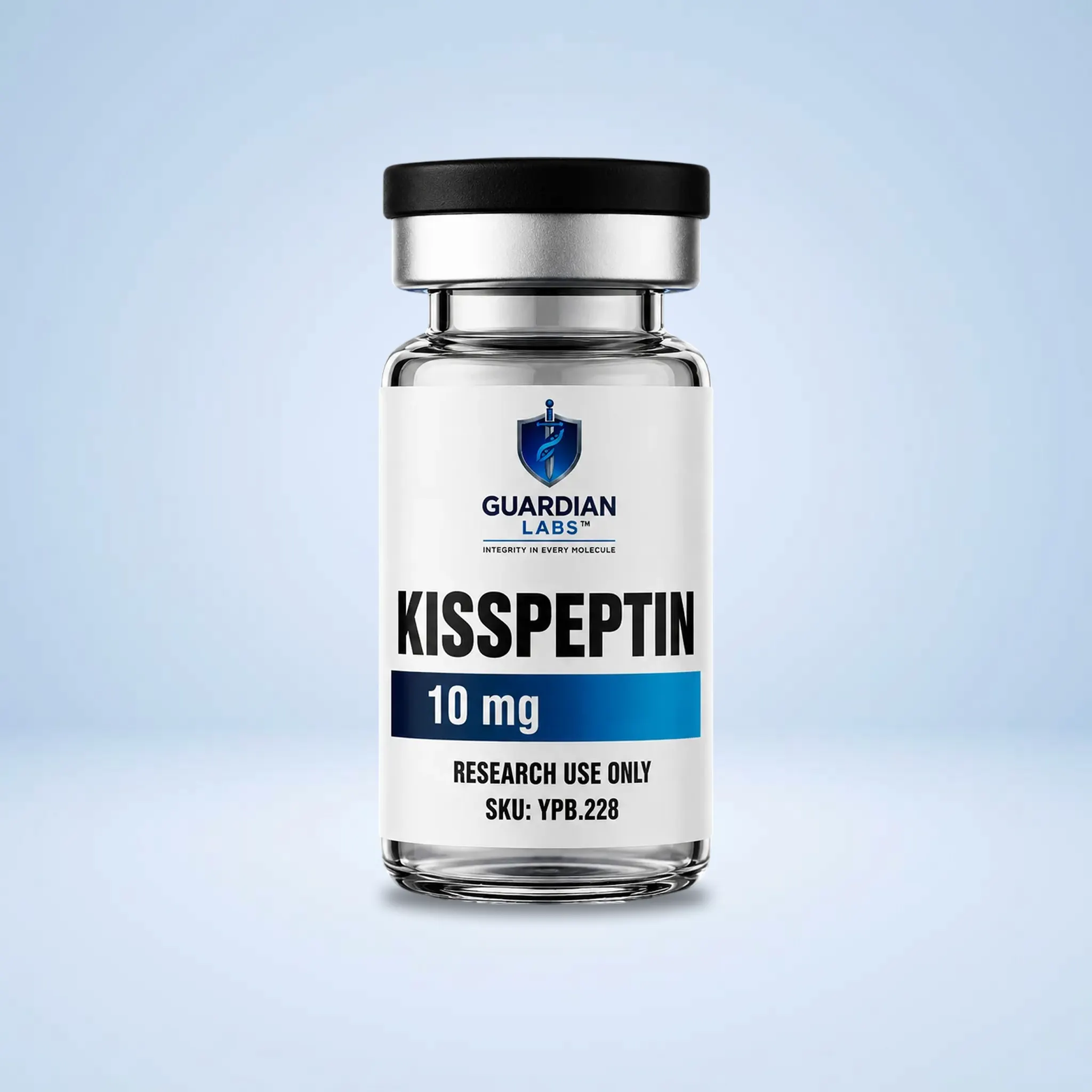
Kisspeptin-10
Metastin (45–54) Amide
A decapeptide agonist of the KISS1R (GPR54) receptor — the most upstream known regulator of the reproductive axis, and the master signal that initiates GnRH release and governs the onset of puberty.
The master switch of the reproductive axis — one tier above every hormone it commands.
| Kisspeptin-10 is the shortest bioactive fragment of the kisspeptin family, corresponding to the C-terminal residues 45–54 of the KISS1 gene product (metastin). As a high-affinity agonist of the KISS1R / GPR54 receptor, it sits at the very top of the hypothalamic–pituitary–gonadal (HPG) hierarchy — the signal that tells GnRH neurons when to fire.
At Guardian Labs, Kisspeptin-10 is supplied as a research-grade lyophilized powder, HPLC-verified above ninety-nine percent purity and lot-verified, so your neuroendocrine, reproductive, and receptor-signaling data remain accurate and reproducible. |
Loss-of-function mutations in the KISS1R receptor prevent the onset of puberty entirely — a discovery that placed kisspeptin at the center of modern reproductive neuroendocrinology.
|
Four sequential steps — from receptor binding to gonadal output.
i
KISS1R ActivationBinds the GPR54 (KISS1R) receptor with nanomolar affinity, triggering Gq-coupled calcium mobilization in target neurons — the initiating event of the cascade. |
ii
GnRH ReleaseActivates hypothalamic GnRH neurons to secrete gonadotropin-releasing hormone in a pulsatile pattern — the rhythm that drives the entire reproductive axis. |
iii
LH & FSH CascadeGnRH signals the anterior pituitary to release luteinizing hormone and follicle-stimulating hormone, the gonadotropins that command downstream steroidogenesis. |
iv
Central & Peripheral RolesBeyond the HPG axis, KISS1R signaling is studied in emotional and behavioral processing, bone (osteoblast differentiation), and metabolic regulation. |
On Upstream Regulation
Unlike peptides that act at the pituitary or gonad, kisspeptin operates one level higher — at the hypothalamic neurons that gate GnRH itself. This upstream position, working through the body’s own pulsatile machinery rather than overriding it, is precisely why kisspeptin has become a leading subject in fertility and reproductive-axis research.
Primary subjects of investigation — strictly laboratory use.
A.01
Reproductive EndocrinologyStudies of HPG-axis regulation, LH/FSH pulse dynamics, and the neuroendocrine control of gonadotropin secretion. |
A.02
Fertility & Oocyte ModelsResearch into kisspeptin as an oocyte-maturation trigger and its potential to reduce ovarian hyperstimulation in assisted-reproduction models. |
A.03
Puberty & DevelopmentInvestigating KISS1R receptor mutations, the timing of pubertal onset, and developmental sex-hormone signaling. |
A.04
Neuroendocrine & BehaviorExamining kisspeptin’s central role in emotional and behavioral processing, and in models of hypothalamic amenorrhea. |
Peer-reviewed literature supporting the research potential of this neuropeptide.
| i. |
Potent Stimulation of Luteinizing HormoneA clinical investigation demonstrating that kisspeptin-10 administration robustly stimulates luteinizing hormone secretion and increases LH pulse frequency — establishing its role as a direct upstream driver of the reproductive axis. |
|
| ii. |
Fertility & Reduced Hyperstimulation RiskResearch examining kisspeptin as a trigger for oocyte maturation, reporting suppression of the signaling associated with ovarian hyperstimulation syndrome — an area of active interest in assisted-reproduction models. |
|
| iii. |
Central Emotional & Behavioral ProcessingNeuroimaging studies indicating that kisspeptin modulates brain activity in regions governing emotional and behavioral response — extending its research relevance beyond peripheral endocrinology. |
|
| iv. |
Osteoblast Differentiation via GPR54An exploratory analysis reporting that kisspeptin-10 promotes osteoblast differentiation through GPR54-mediated BMP2 signaling — one of several peripheral pathways now under investigation. |
Certificate of analysis available upon request.
| Chemical Name | Kisspeptin-10 (human) · Metastin (45–54) Amide |
| Sequence | H-Tyr-Asn-Trp-Asn-Ser-Phe-Gly-Leu-Arg-Phe-NH₂ |
| Molecular Formula | C₆₃H₈₃N₁₇O₁₄ |
| Molecular Weight | 1302.45 g/mol |
| CAS Number | 374675-21-5 |
| Receptor Target | KISS1R / GPR54 |
| Format | Lyophilized Powder (Freeze-dried) |
| Vial Size | 10 mg |
| Purity | > 99% (HPLC Verified) |
| Storage | Store at −20°C · Protect from light |
| Reconstitution | Bacteriostatic Water |








Reviews
There are no reviews yet.