

Description
Product > Description (Text/HTML tab)
============================================================= –>
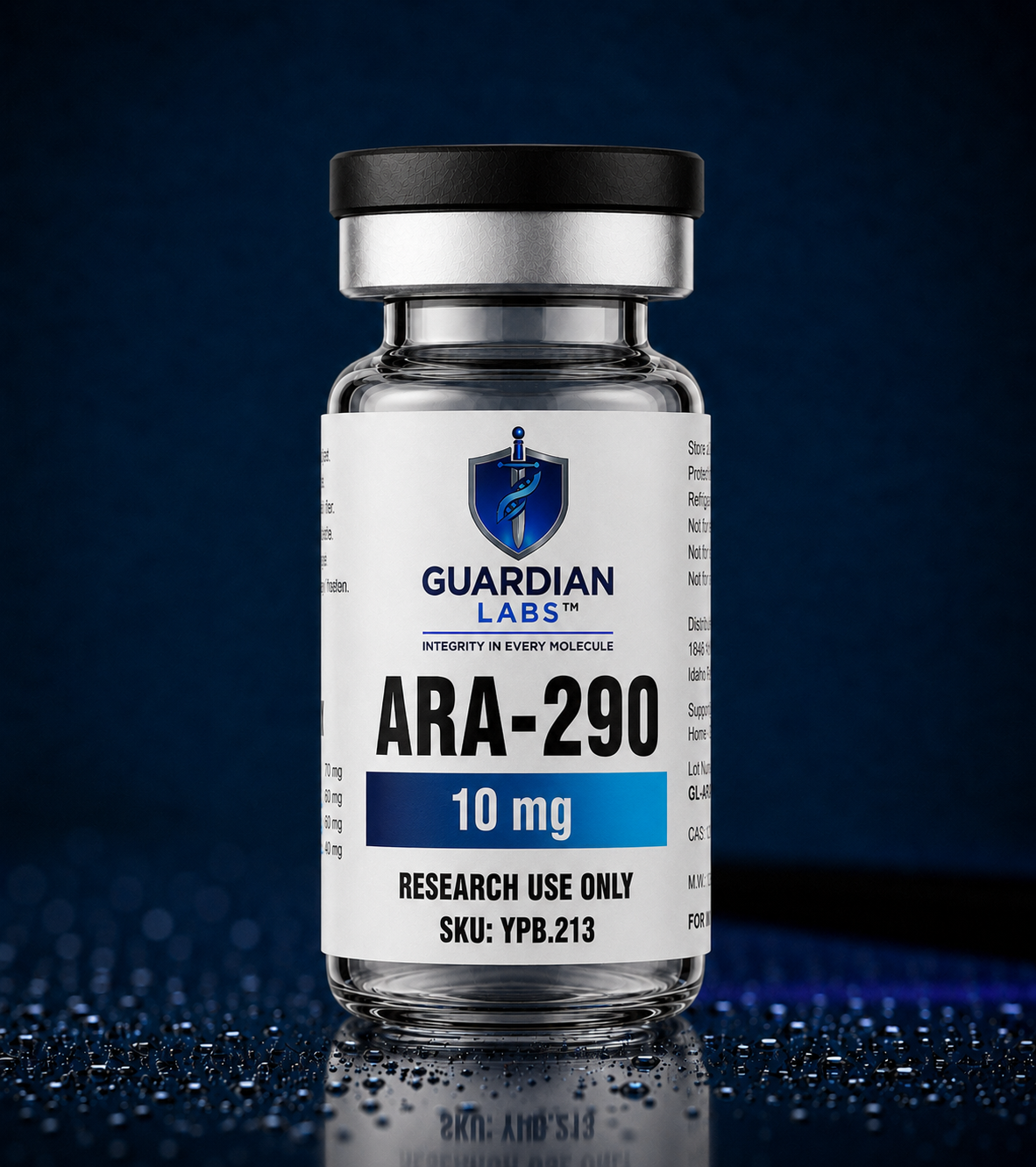
ARA-290
Cibinetide · Helix-B Surface Peptide
An 11-amino acid non-erythropoietic peptide derived from the helix-B domain of erythropoietin — engineered to activate the Innate Repair Receptor and trigger tissue-protective, anti-inflammatory signaling without stimulating red blood cell production.
§ 01 — The Peptide
The tissue-protective half of erythropoietin — isolated from the red-cell-building half.
| ARA-290, known by its clinical name cibinetide, is a synthetic 11-amino acid peptide that reproduces the three-dimensional structure of the helix-B surface of erythropoietin (EPO). Developed by Araim Pharmaceuticals, it was engineered to retain EPO’s cytoprotective and anti-inflammatory signaling while removing its erythropoietic activity entirely.
At Guardian Labs, ARA-290 is supplied as a research-grade lyophilized powder, HPLC-verified above ninety-nine percent purity and lot-verified — ensuring your tissue-protection, neuropathy, and inflammation data remain accurate and reproducible. |
The Innate Repair Receptor is upregulated only on stressed, injured, or inflamed tissue — making ARA-290 a context-restricted repair signal rather than a systemic agonist.
|
§ 02 — Mechanism of Action
Four defining features — how a fragment of EPO becomes a targeted repair signal.
i
Innate Repair ReceptorBinds the IRR — a heterocomplex of the EPO receptor (EPOR) and the β-common receptor (CD131) — distinct from the classical homodimeric EPOR that drives erythropoiesis. |
ii
Context-RestrictedThe IRR is expressed locally on injured or inflamed tissue rather than constitutively — so activation is confined to sites of stress, not the whole system. |
iii
Downstream CascadesTriggers JAK2/STAT3, PI3K/Akt, and anti-apoptotic Bcl-2-family signaling — an anti-inflammatory and cytoprotective program with effects persisting well beyond clearance. |
iv
Non-ErythropoieticDissociates EPO’s tissue-protective effects from red-cell stimulation — activating repair signaling without elevating hematocrit or red-cell mass. |
✦
On Selective Action
Because the Innate Repair Receptor appears only where tissue is damaged, ARA-290 has a plasma half-life of roughly two minutes yet exerts biological effects lasting 24–72 hours through its downstream cascades. This “signal where needed, silent elsewhere” profile is the central reason the IRR pathway has drawn broad interest across neuropathy, ischemia, and inflammation research.
§ 03 — Research Applications
Primary subjects of investigation — strictly laboratory use.
A.01
Neuropathic PainStudies of small-fiber neuropathy, including sarcoidosis- and diabetes-associated models, and the integration of immune signaling with nociception. |
A.02
Tissue ProtectionResearch into anti-apoptotic, cytoprotective signaling in ischemic, metabolic, and transplantation models such as isolated islet survival. |
A.03
Inflammation & ImmunityInvestigating the IRR’s anti-inflammatory program across cytokine pathways, microglial activation, and experimental colitis models. |
A.04
Nerve RegenerationExamining recovery of corneal and peripheral nerve fiber abundance and the role of the IRR in axonal repair. |
§ 04 — Scientific References
Peer-reviewed literature supporting the research potential of this peptide.
| i. |
Sarcoidosis Small-Fiber NeuropathyA randomized, double-blind pilot study evaluating ARA-290 in sarcoidosis patients with symptoms of small-fiber neuropathy, reporting improvements in neuropathic symptom measures — the foundational clinical investigation of the peptide. |
View on PubMed → |
| ii. |
Corneal Nerve Fiber RecoveryResearch reporting that cibinetide improved corneal nerve fiber abundance in patients with sarcoidosis-associated small nerve fiber loss and neuropathic pain — evidence of measurable nerve-regeneration signaling. |
View on PubMed → |
| iii. |
Innate Immune ModulationAn investigation demonstrating that cibinetide dampens innate immune cell activity and ameliorates experimental colitis in animal models — extending the IRR’s relevance across inflammatory conditions. |
View on PubMed → |
| iv. |
The Receptor That Tames Innate ImmunityA foundational review by the peptide’s developers characterizing the Innate Repair Receptor as the integration point between EPO’s cytoprotective signaling and the innate immune response — the mechanistic basis for the field. |
View on PubMed → |
§ 05 — Product Specifications
Certificate of analysis available upon request.
| Chemical Name | ARA-290 · Cibinetide (pHBSP) |
| Sequence | pGlu-Glu-Gln-Leu-Glu-Arg-Ala-Leu-Asn-Ser-Ser |
| Molecular Formula | C₅₁H₈₄N₁₆O₂₁ |
| Molecular Weight | 1257.3 g/mol |
| CAS Number | 1208243-50-8 |
| Receptor Target | Innate Repair Receptor (EPOR / CD131) |
| Format | Lyophilized Powder (Freeze-dried) |
| Vial Size | 10 mg |
| Purity | > 99% (HPLC Verified) |
| Storage | Store at −20°C · Protect from light |
| Reconstitution | Bacteriostatic Water |
Research Use OnlyAll products listed are intended exclusively for laboratory research and development purposes. They are not intended for human consumption, diagnostic, or therapeutic use. Customers must be at least 21 years of age to purchase.

Reviews
There are no reviews yet.