

Description
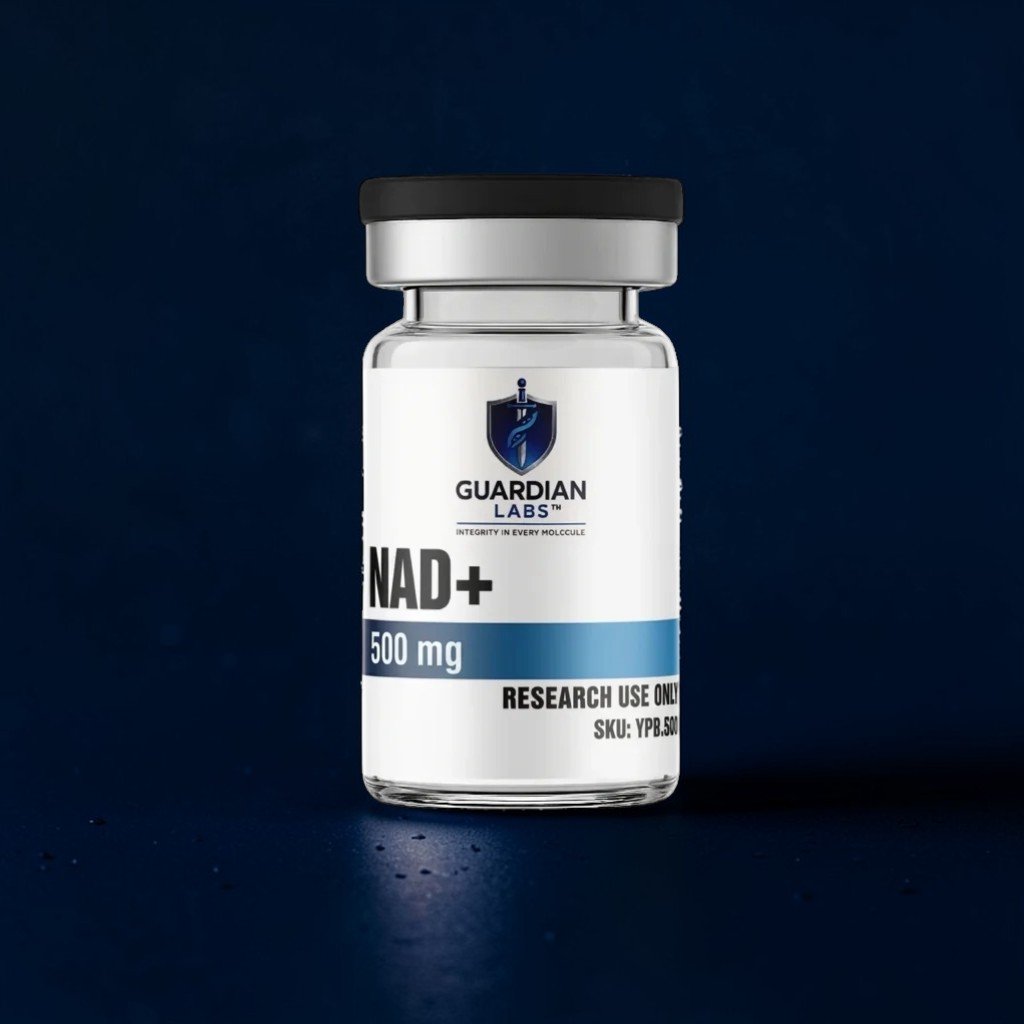
NAD+
Nicotinamide Adenine Dinucleotide
An essential pyridine coenzyme present in every living cell — central to mitochondrial energy production, DNA repair, and the sirtuin pathways that govern cellular aging.
§ 01 — The Coenzyme
A fundamental molecule of cellular metabolism — studied for decades, re-discovered for longevity.
| Nicotinamide Adenine Dinucleotide (NAD+) is a coenzyme found in every living cell, functioning as the primary electron carrier in cellular respiration. It exists in a continuous equilibrium with its reduced form (NADH), shuttling electrons through the mitochondrial electron transport chain to drive ATP synthesis.
At Guardian Labs, we provide research-grade NAD+ rigorously tested to ensure purity exceeding ninety-nine percent — ensuring your laboratory data regarding bioenergetic, longevity, and neurochemical investigations remains accurate and reproducible. |
NAD+ levels decline measurably with age across mammalian tissues — a decline now recognized as a central feature of cellular senescence and a principal target of longevity research.
|
§ 02 — Biochemical Roles
Four intersecting pathways — where NAD+ governs cellular outcome.
i
Redox & ATPActs as the primary electron carrier between glycolysis, the TCA cycle, and the electron transport chain — driving mitochondrial ATP synthesis. |
ii
Sirtuin ActivationRequired cofactor for SIRT1-SIRT7 deacetylases, which regulate gene expression, stress response, and mitochondrial biogenesis. |
iii
DNA RepairConsumed by PARP enzymes during the repair of single- and double-stranded DNA breaks — a key link between NAD+ depletion and aging. |
iv
Calcium SignallingSubstrate for CD38 and related enzymes that generate cyclic ADP-ribose, modulating intracellular calcium and immune response. |
✦
On the Age-NAD+ Axis
NAD+ concentrations in human tissues decline by as much as fifty percent between early adulthood and old age. Restoring NAD+ levels in aged mammalian models has been shown to improve mitochondrial function, enhance DNA repair capacity, and extend healthspan — framing NAD+ as one of the most actively studied molecules in modern geroscience.
§ 03 — Research Applications
Primary subjects of investigation — strictly laboratory use.
A.01
Longevity & AgingStudies on the age-related decline of NAD+ and the effects of precursor supplementation on sirtuin activity and cellular senescence. |
A.02
Mitochondrial FunctionResearch into NAD+-dependent bioenergetics, oxidative phosphorylation efficiency, and mitochondrial biogenesis in metabolic models. |
A.03
NeuroprotectionInvestigating NAD+’s role in neuronal survival, axonal integrity, and models of cognitive decline and neurodegenerative disease. |
A.04
Metabolic & RecoveryStudies examining NAD+ in metabolic dysfunction, substance-use recovery models, and restoration of cellular energy homeostasis. |
§ 04 — Scientific References
Peer-reviewed literature supporting the research potential of this coenzyme.
| i. |
Age-Related Decline of NAD+A foundational study demonstrating that tissue NAD+ levels fall substantially with age across mammalian species, with measurable consequences for mitochondrial function and sirtuin-mediated gene regulation — establishing the framework for NAD+ restoration research. |
View on PubMed → |
| ii. |
Mitochondrial & Metabolic FunctionThis study examined the effect of restoring NAD+ levels on mitochondrial respiration and metabolic flexibility. Results indicated significant improvements in oxidative capacity and insulin sensitivity in aged models, suggesting a therapeutic window for metabolic intervention. |
View on PubMed → |
| iii. |
Neuroprotection & Cognitive FunctionInvestigators reported that NAD+ administration attenuated axonal degeneration and improved cognitive performance in models of neurodegeneration — supporting a mechanistic role for NAD+ in neuronal resilience and synaptic integrity. |
View on PubMed → |
| iv. |
Substance Recovery & Cellular HomeostasisAn exploratory analysis examining NAD+ in models of substance withdrawal found associations with restored cellular energy markers and reduced oxidative stress — one of several lines of inquiry now expanding into recovery-adjacent research. |
View on PubMed → |
§ 05 — Product Specifications
Certificate of analysis available upon request.
| Chemical Name | β-Nicotinamide Adenine Dinucleotide |
| Molecular Formula | C₂₁H₂₇N₇O₁₄P₂ |
| Molecular Weight | 663.43 g/mol |
| CAS Number | 53-84-9 |
| Format | Lyophilized Powder (Freeze-dried) |
| Vial Size | 500 mg |
| Purity | > 99% (HPLC Verified) |
| Storage | Store at −20°C |
| Reconstitution | Bacteriostatic Water |
Research Use OnlyAll products listed are intended exclusively for laboratory research and development purposes. They are not intended for human consumption, diagnostic, or therapeutic use. Customers must be at least 18 years of age to purchase.

Reviews
There are no reviews yet.